




Aug
Uncategorized
AI and the Future of Gemstone Identification: Swiss International Gemlab Opens a New Path Forward!
As artificial intelligence begins to work alongside expert knowledge and experience, the gemstone identification industry is entering a noteworthy period of transformation.
For decades, gemstone identification and origin determination have relied heavily on experts’ knowledge, practical experience, and analytical skills. However, the rapid development of data technology and artificial intelligence (AI) is opening up new approaches to support these processes.
Swiss International Gemlab (SIG) is a newly established gemological laboratory founded by three experienced industry professionals. It currently operates in Lucerne, Switzerland, and Hong Kong.
1. Swiss International Gemlab – Combining Expertise and Technology
SIG was founded by Willy Bieri, Lawrence Hahn, and Matthias Alessandri, all of whom have extensive experience in gemology, laboratory operations, and the gemstone trade.
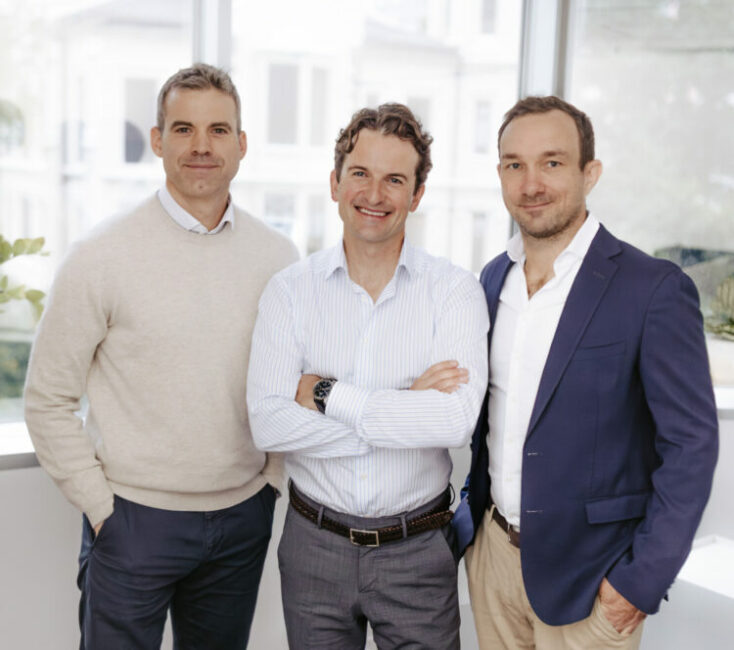
The founding team has worked across a wide range of markets, from Europe and the United States to Asia, and has examined a very large number of gemstone samples. Building on this experience, the new laboratory was established with a focus on combining modern analytical methods, particularly spectroscopy and data analysis.
The goal is to deliver results that are more reliable, easier to understand, and more consistent, while providing customers with a more transparent and convenient experience.
2. AI Does Not Replace Experts
One of the most notable aspects of SIG’s model is its SIG-AI Assistance system, a proprietary AI system designed to support experts during the identification and grading processes.

AI is used to assist with data analysis, optimize workflows, and improve consistency across the laboratory’s services. The technology is also applied to support the process of determining gemstone origin.
However, SIG emphasizes that AI cannot independently address all the challenges involved in origin determination.
Determining the origin of a gemstone is not simply a matter of feeding data into a system and receiving an answer. It requires a combination of scientific data, observational expertise, and knowledge accumulated through the study of thousands of gemstone samples by experienced professionals.
Therefore, SIG views AI as a tool that amplifies scientific capabilities, enabling data to be processed more quickly and efficiently rather than replacing experts.
3. Origin Determination – A Major Challenge in Colored Gemstones
In the field of colored gemstones, origin determination has always been one of the most complex and closely watched services in the market.
SIG states that the laboratory is building a reference collection of ruby, sapphire, emerald, and other commercially valuable gemstones. Samples are collected directly from mines or acquired from the market in order to continuously expand the database used for analytical purposes.
This highlights an important factor in AI technology.
The richer and better standardized the database, the more effectively AI can support experts in the analytical process.
4. Color Standardization – A Noteworthy Approach
In addition to identification and origin determination, SIG also provides gemstone color grading services.
The laboratory has developed standardized color sample sets for ruby, sapphire, emerald, and several other gemstones, including copper-bearing tourmaline.
The samples are selected from the market and evaluated collectively by the expert team to develop color sets that maintain consistency across different gemstone types and between the laboratory’s locations.
SIG has also developed a standardized lighting box system to help ensure that gemstone colors are represented more consistently during evaluation.
Standardizing the process can help reduce differences in grading approaches and create a more consistent color classification system.
5. SIG Uses Familiar Commercial Terminology
In its reports, SIG continues to use several color terms commonly recognized in the market, such as “royal blue” and “pigeon’s blood.” However, the grading process is based on the laboratory’s standardized color sample sets.
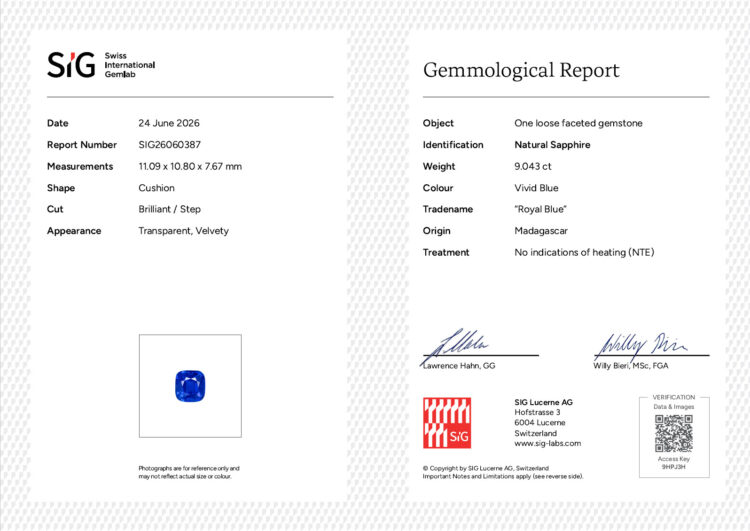
For copper-bearing tourmaline, the report clearly identifies the mineral species, such as cuprian elbaite tourmaline or cuprian liddicoatite tourmaline.
For colors ranging from blue to green, SIG uses the terms “Paraíba color” or “Paraíba neon color”, depending on the level of saturation, together with appropriate notes on the report.
This approach demonstrates a balance between using terminology familiar to the market and maintaining a clearly defined classification system.
6. From Switzerland to Hong Kong
SIG currently operates in Lucerne, Switzerland, and Hong Kong.
The laboratory was officially introduced at GemGenève in May and continued its activities at the Hong Kong Jewellery & Gem Fair in June. SIG is also expected to participate in the Hong Kong event in September at AsiaWorld-Expo.
Customers can submit gemstones to either location, and the laboratory is continuing to develop its shipping procedures to serve international clients.
Looking ahead, SIG says it is evaluating the possibility of expanding to other locations. For now, however, its focus remains on developing operations in Switzerland and Hong Kong.
7. A Signal of the Future of Gemology
The emergence of Swiss International Gemlab demonstrates that AI is beginning to play a deeper role in the operational processes of gemstone laboratories.
However, the story is not simply about “AI replacing humans.”
Instead, SIG’s model points toward a different approach: using AI to enhance the capabilities of experts.
In an industry where practical experience, observational skills, and scientific data all play critical roles, the combination of human expertise and technology may become an inevitable direction for future development.
For the colored gemstone market, where every stone has its own unique characteristics and factors such as origin, treatment, and color can significantly influence value, improving the speed, consistency, and traceability of the identification process will become increasingly important.

SIG aims to become one of the top three internationally recognized gemological laboratories within the next five years, while emphasizing its commitment to quality and professional ethics.
If this goal is achieved, SIG’s development could represent more than simply the emergence of a new laboratory. It could also signal that the field of gemology is entering an era in which AI technology and human expertise are becoming increasingly interconnected.
Reference Source
Gemworld International – Swiss International Gemlab Launches, Providing AI-Assisted Gemstone Services, (19/08/2026).
